 KARAJAN
The first minutes decide the outcome.
Karajan detects, verifies, and mounts an initial response to wildfires — one autonomous, human-supervised loop, built to compress the ten to twenty minutes that decide whether an ignition stays small or becomes a megafire.
In development with fire services and land managers across Southern Europe.
Wildfires become uncontrollable in minutes, not hours.
Every megafire starts as a single, containable ignition. The window to keep it that way is short — and today it is too often spent looking for the fire, not fighting it.
- 01
Detection isn't the finish line
A thermal alert with no evidence on the ground still leaves crews guessing at location, scale, wind, and access — while the fire keeps growing.
- 02
The response gap
By the time verified information reaches a crew, the most valuable minutes of the ignition are already spent.
- 03
Delay compounds
National data ties response speed directly to outcome: fires reached within five minutes stayed under one hectare in 82% of cases. Beyond two hours, only 39% did.
Source: calculation based on Table 19, MITECO, Wildfires in Spain 2013.
One loop: prevent, detect, confirm, respond.
Karajan runs a continuous operational loop across the protected territory — reasoning about risk, watching for ignitions, verifying evidence at close range, and preparing an initial response, with a human authorising every step that matters.
- A thermal or visual anomaly triggers verification, not a siren.
- An aerial asset reaches the site to confirm evidence before crews are stretched thin.
- Every detection, flight, and decision is logged as evidence, not a black box.
Built the way emergency response demands.
- SUPERVISION01
Human authority, always
Cortex proposes and evidence gets verified — but command authorises. No detection independently releases suppressant.
- PERSISTENCE02
Watching, day and night
Solar-powered, off-grid nodes built to monitor continuously through the fire season — no mains power, no gaps.
- INTEGRATION03
One loop, not a stack
Detection, verification, and response run as a single connected system — not separate tools handed off by radio and hope.
- INTEROPERABILITY04
Built to plug into command
Designed to support fire services and incident command, not replace them — evidence and control stay with the authority in charge.
Cortex and Link: the software behind the loop.
The hardware detects and acts. Cortex and Link are what make it coordinated — fusing evidence, reasoning about risk, and keeping every asset, and every decision, accountable to command.
- Evidence fusion
- Risk estimation
- Mission proposal
- Asset allocation
- Decision log
- Sentinel
- Sensing
- First Responder
- Fire crews
Three systems. One chain of custody.
Each system covers one stage of the loop — watching, verifying, and acting — designed and built to hand off to the next without losing time, or evidence, in between.
 01Persistent monitoring
Sentinel
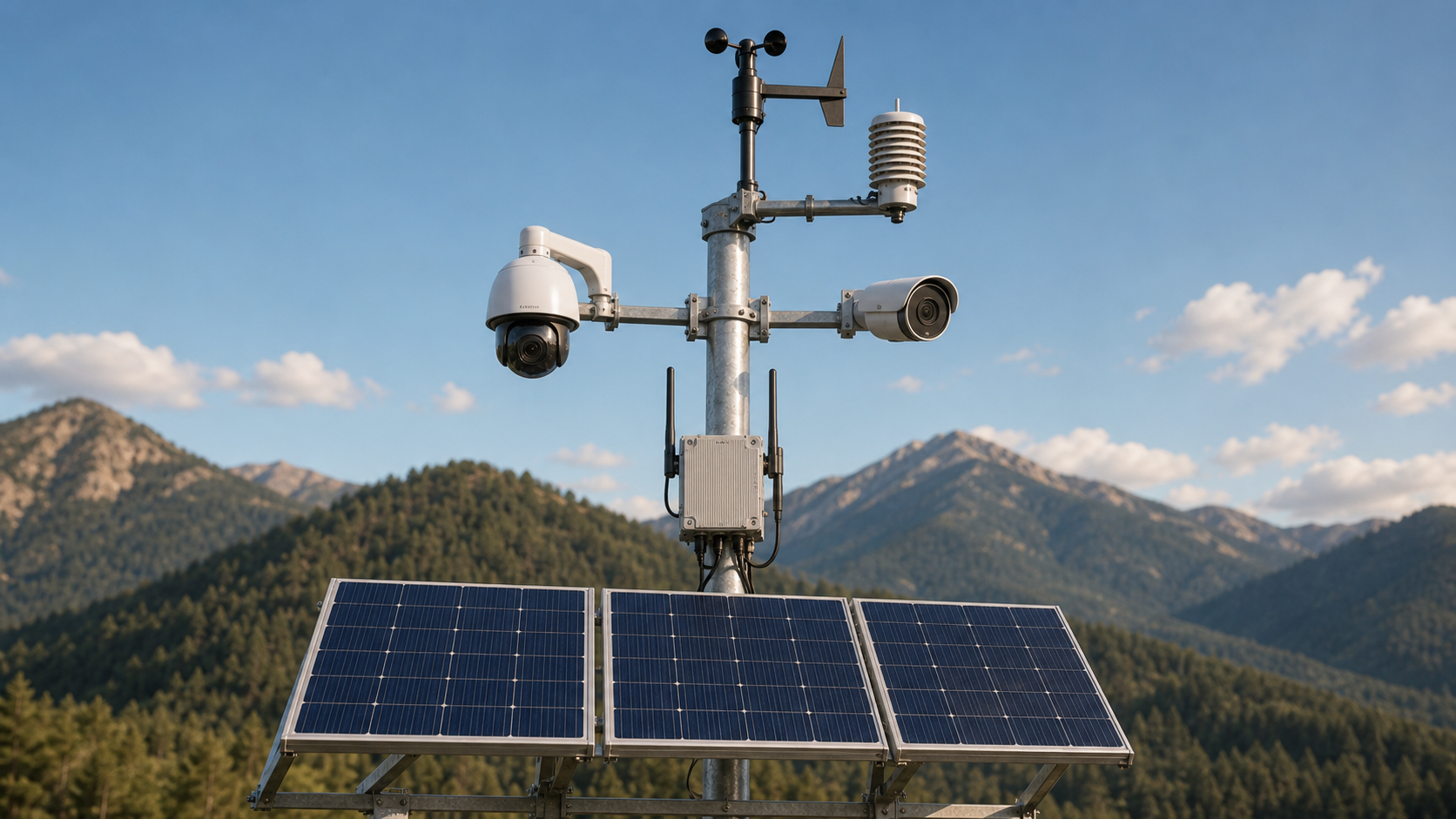
A solar-powered watch tower that monitors the protected territory around the clock — visible and thermal cameras, on-site weather, and edge AI, all in one node.
- 4K visible + thermal cameras on a 10–20 m mast, adjustable to terrain
- On-board weather station: wind, temperature, humidity, rainfall
- Solar + LiFePO₄ battery — days of autonomy with no sun
- Design target: up to 100 km² monitored per node, favourable terrain
 02Close-range verification
Sensing
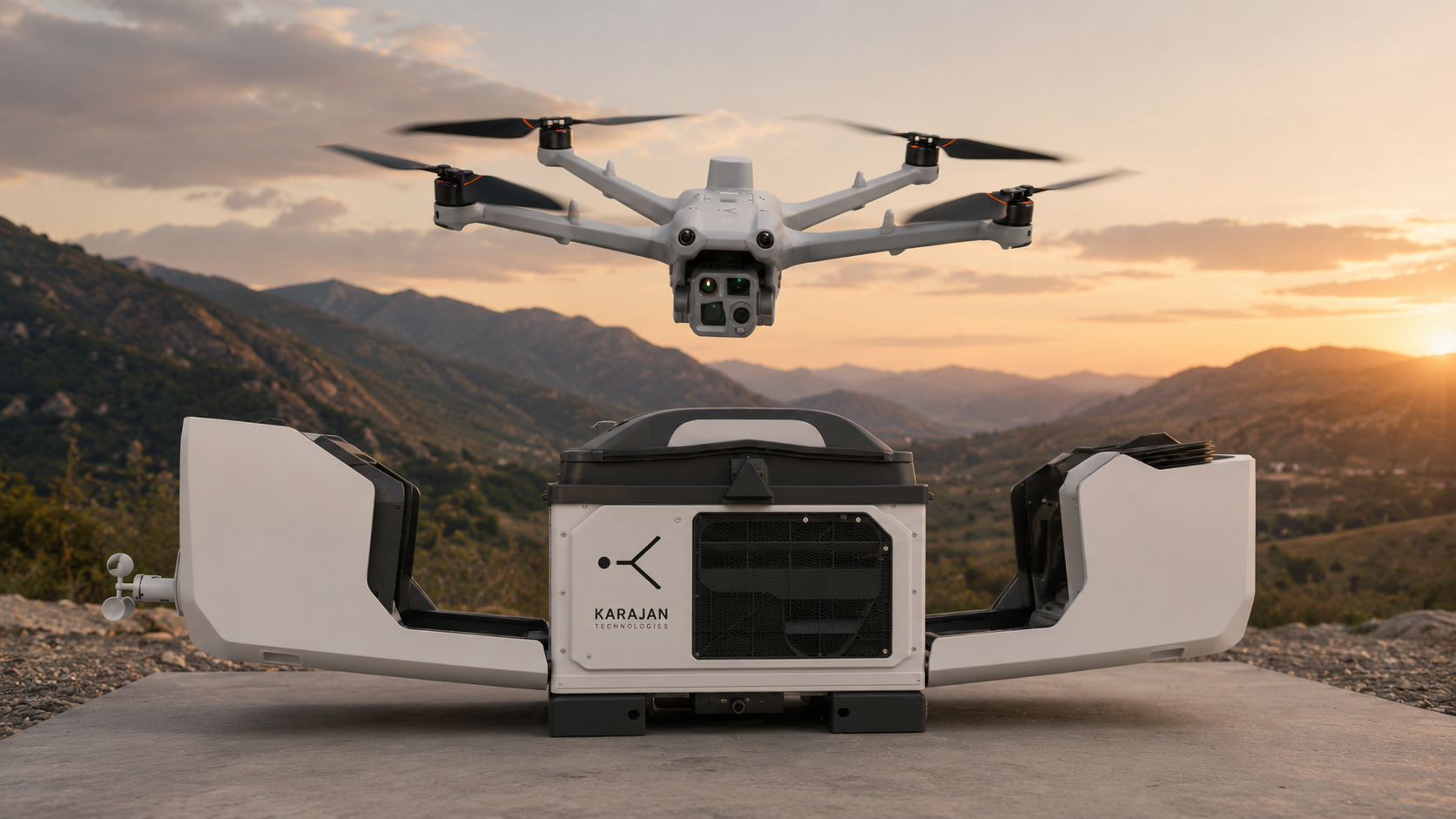
An automated dock keeps an industrial UAV ready to fly to a suspected ignition and confirm it with close-range visible and thermal evidence — before crews are committed.
- Automated dispatch to candidate ignitions flagged by Sentinel
- Design target: verified visible + thermal evidence within minutes
- A supervised operator can redirect or abort the flight at any time
- Feeds local weather and terrain context to command while airborne
 03Initial physical response
First Responder
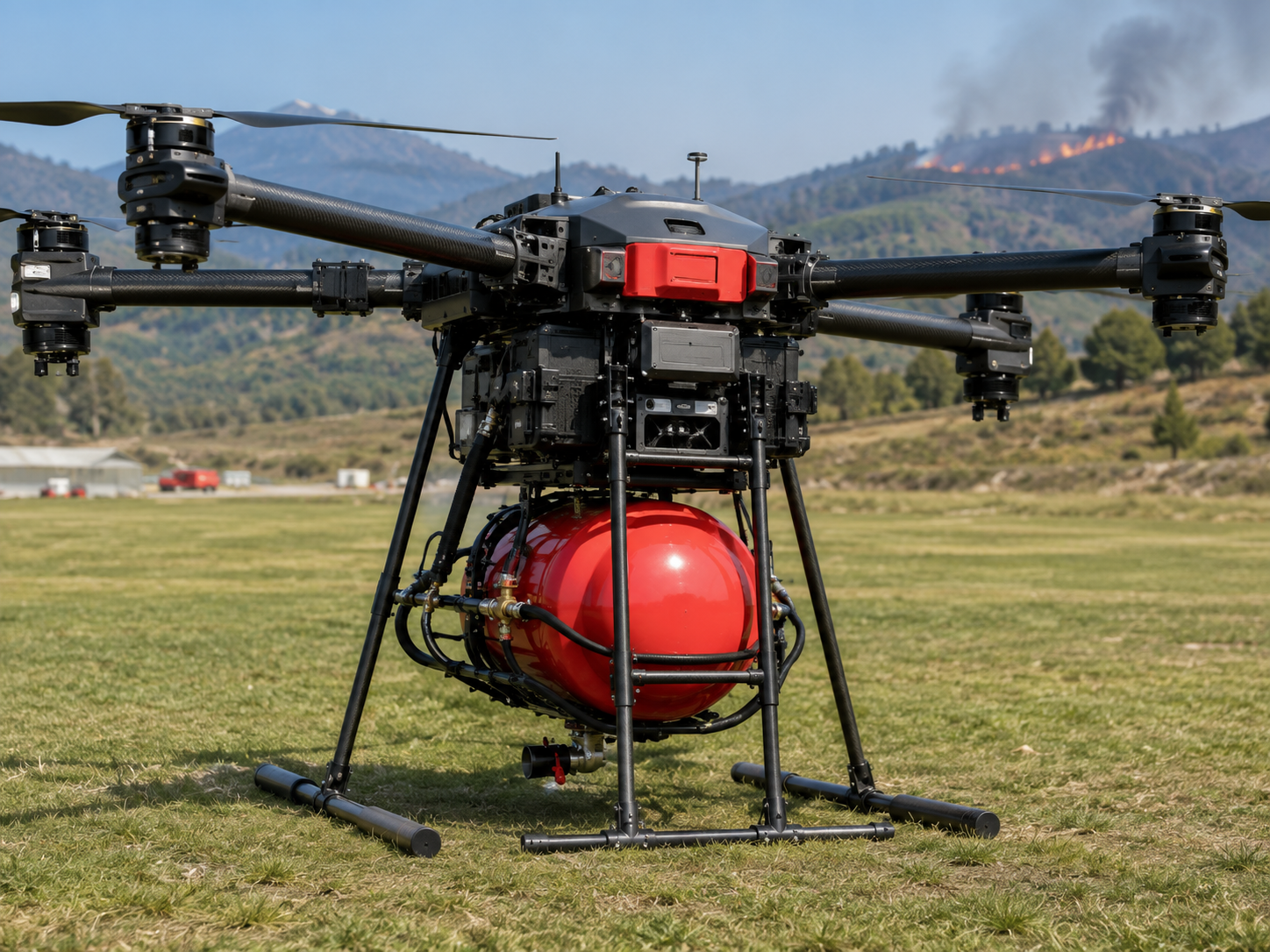
A heavy-lift platform designed to intervene on a confirmed, still-small ignition — buying the minutes a fire crew needs to arrive and take over.
- Up to 80 kg of authorised suppression payload
- ≈170 kg maximum take-off mass
- Deploys only on confirmed evidence, under human authorisation
- Intended to contain or slow an early ignition, not replace aerial firefighting
Figures are current design targets for the system under development, not field-validated performance guarantees.
Every megafire starts as a small fire.
Wildfires don't become unmanageable all at once — they cross a threshold in the minutes nobody was watching closely enough. Karajan is built to hold that threshold: watching continuously, verifying fast, and preparing a response before the fire decides the outcome for us.
Time to action is the variable that changes the outcome.
Request a briefing.
A focused, technical conversation — how the loop fits your territory, and what a first deployment looks like. No sales deck.
Prefer email? Write to contact@karajan.io.